RICH HTML EDITION
Converted from the original DOCX · adapted from weeks to flexible stagesTRAINER ALEXIS’S SOCCER MENTOR How to coach a 6-year-old beginner An eight-stage, one-on-one plan built around joyful games, simple skills, clear boundaries, and a child-first coaching style. |
|
8 STAGES | 45-MINUTE SESSIONS | SIZE 3 BALL | PARENT PRESENT |
★ | THE MISSION: Help her love the ball, trust herself, learn the basics, and leave every session asking when she can play again. |
Created July 2026
Research-informed. Parent-supervised. Designed for practical use on the field.
START HERE
What this guide is trying to accomplish
At six, “prep for soccer” means confidence, coordination, ball familiarity, and joy — not tactics, conditioning, or pressure.
✓ | THE BEST TEST OF A SESSION: Did she smile? Did she touch the ball a lot? Did she learn one small thing? Does she want to come back? |
Realistic outcomes across eight stages
BALL CONFIDENCE • Dribbles without being afraid of mistakes • Stops the ball on command • Uses both feet naturally, without being forced | BASIC CONTROL • Keeps the ball reasonably close in open space • Changes direction with a simple turn • Looks up for a gate, target, or goal |
PASSING + SHOOTING • Uses the inside of the foot for a short pass • Receives a rolling ball with a softer touch • Strikes toward a target with balance | PLAYER HABITS • Tries again after a miss • Understands “ball, goal, space” • Can play a simple 1v1 safely and happily |
How to use the plan
1 | Run one to three coached sessions as schedules allow — Each session is 45 minutes. An optional second session should repeat favorite games rather than add more instruction. |
2 | Read only the stage you need — Bring the field-side page or take a phone screenshot. Trainer Alexis should not be reading paragraphs while the child waits. |
3 | Keep one main teaching point — Every stage has one “one thing to teach.” If the child remembers that one idea, the session worked. |
4 | Adapt to the child in front of you — A six-year-old may be brave in one session and hesitant in the next. Make the game easier before giving another correction. |
5 | Let the parent know the win — After each session, share one success, one favorite game, and one simple focus for next time. |
Research basis: U.S. Soccer’s 4v4 grassroots guidance emphasizes fun, safety, developmentally appropriate environments, player-centered coaching, and Play-Practice-Play. [1]
NON-NEGOTIABLES
Safety and boundaries
Trainer Alexis is the soccer mentor. A responsible adult remains present and responsible for the child, the environment, medical decisions, and emergencies.
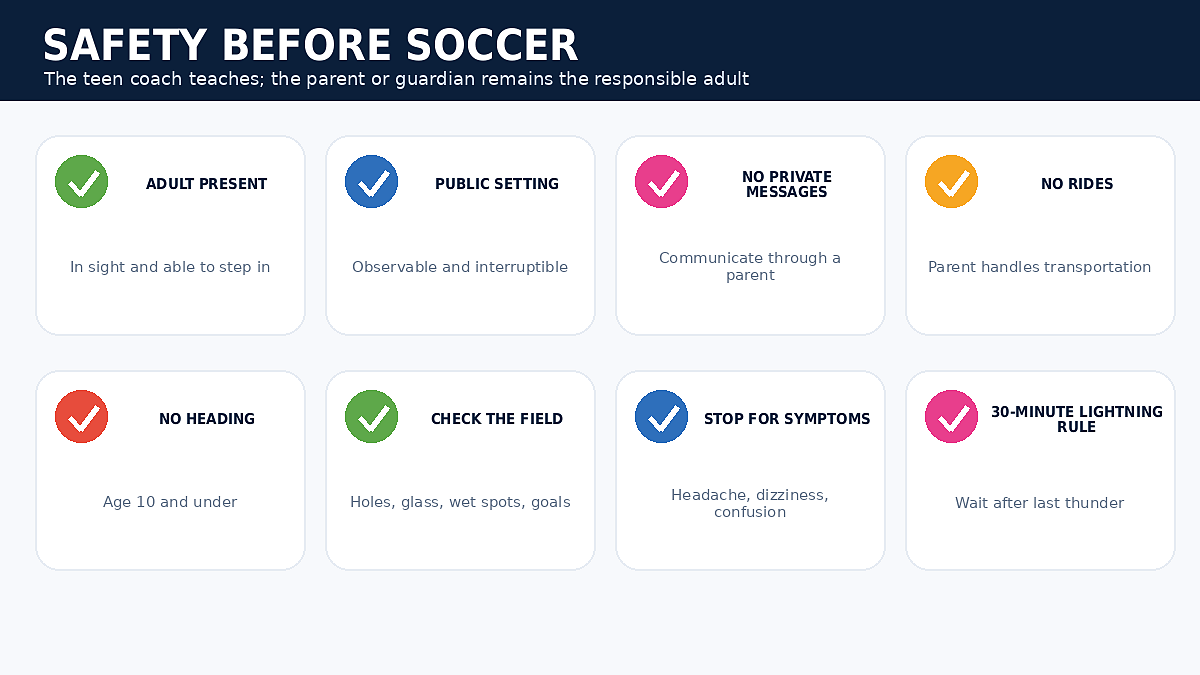
Use adult-level safeguards even though the trainer is also a minor
• At least one responsible adult — ideally the six-year-old’s parent or guardian — stays on-site, in sight, and able to interrupt the session.
• All scheduling, changes, payments, photos, and messages go through parents or guardians. Trainer Alexis should not privately message the six-year-old.
• No rides, private indoor spaces, locker-room situations, changing help, massage, or injury treatment. Get the parent immediately.
• Get written parent permission before the first session. Allow the parent to observe every minute. Follow any club, league, facility, or state rules that are stricter.
• No photos or video unless the parent has clearly approved them. Never post the child publicly without specific parent permission.
Stop play immediately when...
HEAD OR BODY IMPACT • Headache, dizziness, nausea, confusion, balance trouble, unusual behavior, or “I don’t feel right” means stop and get the adult. Do not return that session. [7] | WEATHER TURNS • At thunder or lightning, leave the field for a safe building or vehicle. Outdoor activity resumes only 30 minutes after the last thunder or flash. [8] |
PAIN CHANGES • Sharp pain, limping, swelling, breathing trouble, chest pain, or a child who suddenly looks unwell means stop. The adult decides next steps. | ATTENTION IS GONE • A tired, upset, overheated, or overwhelmed six-year-old is finished learning. Shorten the session without guilt. |
UNDERSTAND THE PLAYER
What a six-year-old is actually like
The fastest way for a good teenage player to become a bad youth coach is to expect a six-year-old to think, move, or focus like a teenager.
i | IMPORTANT: At this age the ball is still a toy, attention shifts quickly, movement skills are developing, and the child often thinks “my ball” before “our team.” That is normal. |
ATTENTION • Use brief directions • Demonstrate instead of explaining • Change activities every 5–9 minutes • Give only one cue at a time | MOVEMENT • Expect awkward turns and balance changes • Use running, hopping, skipping, and stopping inside games • Build recovery breaks into the session |
EMOTIONS • Correct gently • Never embarrass or compare • Celebrate effort and brave attempts • Finish with a success she can feel | SOCCER THINKING • No formation lectures • No position specialization • Dribbling and ball comfort come first • Simple choices: go, stop, turn, pass, shoot |
The practical rules for Trainer Alexis
• Talk for 20 seconds or less, then get the ball moving.
• Use a story or challenge: puppy ball, treasure, gates, shark, castle, escape.
• Offer two choices instead of asking an open-ended question: “Pink game or blue game?”
• Do not correct every touch. Pick one detail, praise what changed, and move on.
• End an activity while she still likes it. Six joyful minutes beats fifteen forced minutes.
• Never punish with running, push-ups, or taking away the ball.
What not to teach yet
NO HEADING | NO SLIDE TACKLES | NO FITNESS BLOCKS | NO TACTICS LECTURE |
U.S. Youth Soccer prohibits players age 10 and under from heading the ball in matches and organized training. Keep every ball away from the child’s head and do not add “fun” heading games. [6]
U.S. Youth Soccer’s coaching manual advises brief directions, short activities, frequent water breaks, a 45-minute limit, and a ball available to every U-6 player. [2]
BEFORE THE FIRST SESSION
Equipment, field setup, and adult preparation
Keep the setup small. More space and more equipment do not make a better session.
PLAYER GEAR • Size 3 soccer ball [3] • Shin guards — safest default for the whole session • Athletic shoes or properly fitted cleats • Water bottle, weather-appropriate clothing, sunscreen | COACH GEAR • 8–12 disc cones in 3–4 colors • Two pop-up mini goals or four cones for goals • One spare size 3 ball • Phone/timer kept with the adult, not used while coaching |
SAFETY GEAR • Adult-held first-aid kit • Emergency contact and medical notes • Any child medication stays with the parent • Anchored goals only — never hang or climb | GOOD TRAINING SPACE • Flat grass or safe turf • Public and visible • No holes, glass, standing water, or hard obstacles • Enough shade or a nearby safe shelter |
Simple 1-on-1 field
Use a rectangle about 10 x 15 yards for most games. Make it smaller when the ball runs away too often; make it larger when the child cannot find space. Cone goals should be 3–5 feet wide. This is a training adaptation — not an official match field.
SMALL BOX 10 x 15 yards | CONE GOALS 3–5 feet wide | WATER EDGE Bottles outside play |
Five-minute adult check before play
• Parent confirms allergies, asthma, recent injuries, medical limitations, emergency contact, and whether the child has played before.
• Adult checks weather, field hazards, goal stability, footwear, shin guards, jewelry, and ball pressure.
• Trainer Alexis explains the session in one sentence: “We will play games with the ball for about 45 minutes, and you can take a break anytime.”
• Child chooses a cone color or game name. That tiny choice helps create ownership.
U.S. Soccer’s 4v4 standards use a size 3 ball, require shin guards for games, remove goalkeepers, and prioritize a fun and safe environment. [3]
HOW TRAINER ALEXIS SHOULD COACH
Play first. Teach one thing. Play again.
This is a one-player adaptation of U.S. Soccer’s Play-Practice-Play idea: let the child experience the game, add a small teaching point, then return to a game where she can use it. [1]
The five-part coaching loop
1 | SHOW — Demonstrate once at child speed. Stand beside her, not ten yards away. |
2 | SAY ONE CUE — Use a short phrase: “tiny touches,” “freeze it,” “plant beside it,” or “body between.” |
3 | LET HER TRY — Give several attempts before talking again. Do not narrate every touch. |
4 | PRAISE SOMETHING TRUE — Name the behavior: “You looked up before the gate,” not just “good job.” |
5 | PLAY ON — Turn the skill into a race, story, target, or 1v1. Soccer is the teacher. |
Language that works
SAY THIS | AVOID THIS |
“Try it your way first.” | “No, that’s wrong.” |
“Can you keep the ball close like a puppy?” | “Control the ball better.” |
“I saw you try again.” | “You should know this.” |
“One change: plant beside the ball.” | A list of four corrections. |
“Water, then pink game or blue game?” | “Why aren’t you listening?” |
“What was your favorite part?” | A post-session lecture. |
↻ | WHEN SHE MISSES: Do not perform a technical autopsy. Say “brave try,” give one cue only if needed, and restart quickly. |
SESSION ZERO
The first meeting and no-pressure baseline
The goal is not to test or rank her. Trainer Alexis is quietly learning what the child enjoys, what feels hard, and how much instruction she can handle.
15-minute parent conversation
• What does the parent mean by “prep for soccer” — confidence, first team experience, tryout readiness, fitness, or basic skills?
• Has she played before? What does she love or avoid? Is she afraid of the ball or of making mistakes?
• Any allergies, asthma, recent injuries, sensory needs, attention needs, medications, or restrictions?
• Who will be the adult present every session? Where will sessions happen? What is the lightning/heat backup plan?
• Agree that success is participation and progress — not turning a six-year-old into a travel player across the eight stages.
Quiet baseline games
TIME | ACTIVITY | HOW TO RUN IT |
|---|---|---|
3 min | Free ball play | Say: “Show me what you like to do with the ball.” Watch comfort, dominant foot, and imagination. Do not correct. |
4 min | Dribble + stop | Place two cone gates. Ask her to dribble to a gate and freeze the ball. Watch touch size and balance. |
3 min | Roll + pass | Roll the ball from 5–7 feet. Ask her to stop it and pass it back. Watch whether she uses the toe or inside. |
3 min | Shoot at a cone goal | Let her choose the distance. Watch balance, target awareness, and whether she enjoys scoring. |
2 min | Favorite replay | Ask which game she wants one more time. Her choice tells you what motivates her. |
Record observations without labeling the child
WRITE • “Ball often gets 5–8 feet away” • “Smiles during shooting” • “Needs a demo more than words” • “Stops with sole after two tries” | DO NOT WRITE • “Bad dribbler” • “Not athletic” • “Doesn’t listen” • “Weak left foot” |
✦ | PARENT UPDATE EXAMPLE: “She loved shooting and was comfortable trying things. Next week we’ll work on smaller dribbling touches and stopping the ball. Her favorite game was the two-goal race.” |
EVERY SESSION
The repeatable 45-minute structure
Predictability helps the child feel safe. The games change; the rhythm stays familiar.
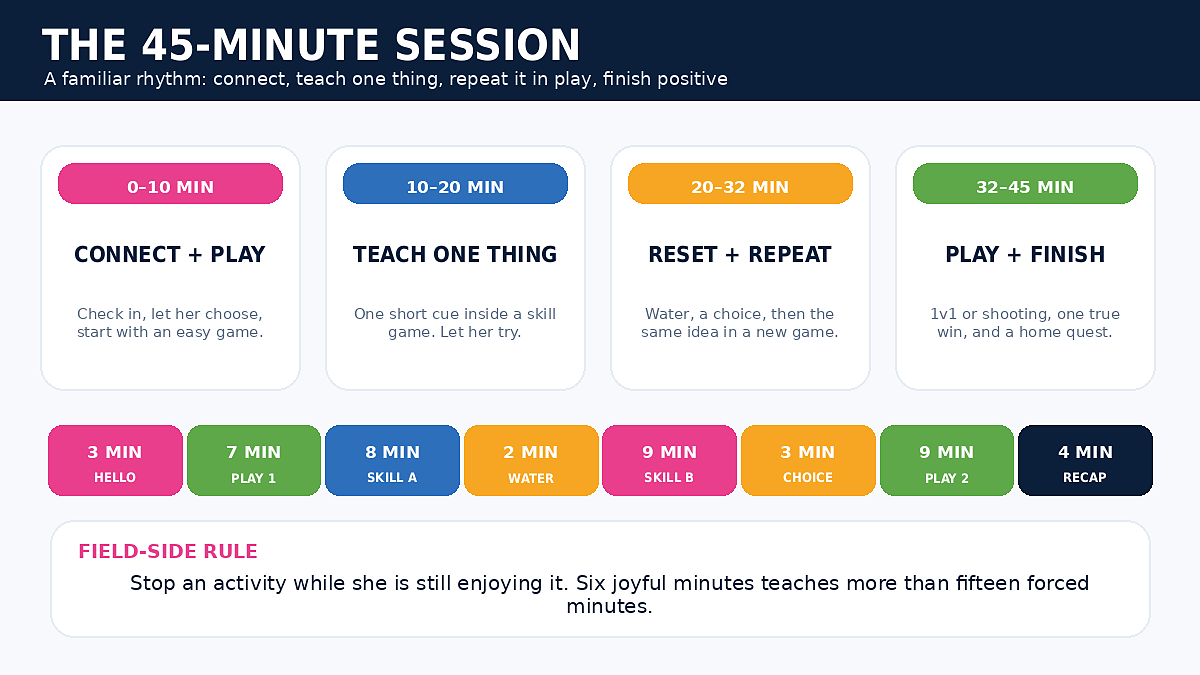
Why this structure works
• It begins with play instead of a lecture.
• It alternates active blocks with two short water/choice resets.
• It repeats the stage skill in different games instead of drilling one exercise too long.
• It ends with a game and a positive memory, not conditioning.
• It keeps the coached session within the 45-minute U-6 guidance in the U.S. Youth Soccer manual. [2]
2 | OPTIONAL SECOND SESSION: Repeat the two favorite games and the final 1v1. Do not race ahead to next stage’s skill. Repetition is learning. |
THE PLAN
Eight stages at a glance
The sequence moves from comfort to control, then adds passing, shooting, defending, and simple decisions.
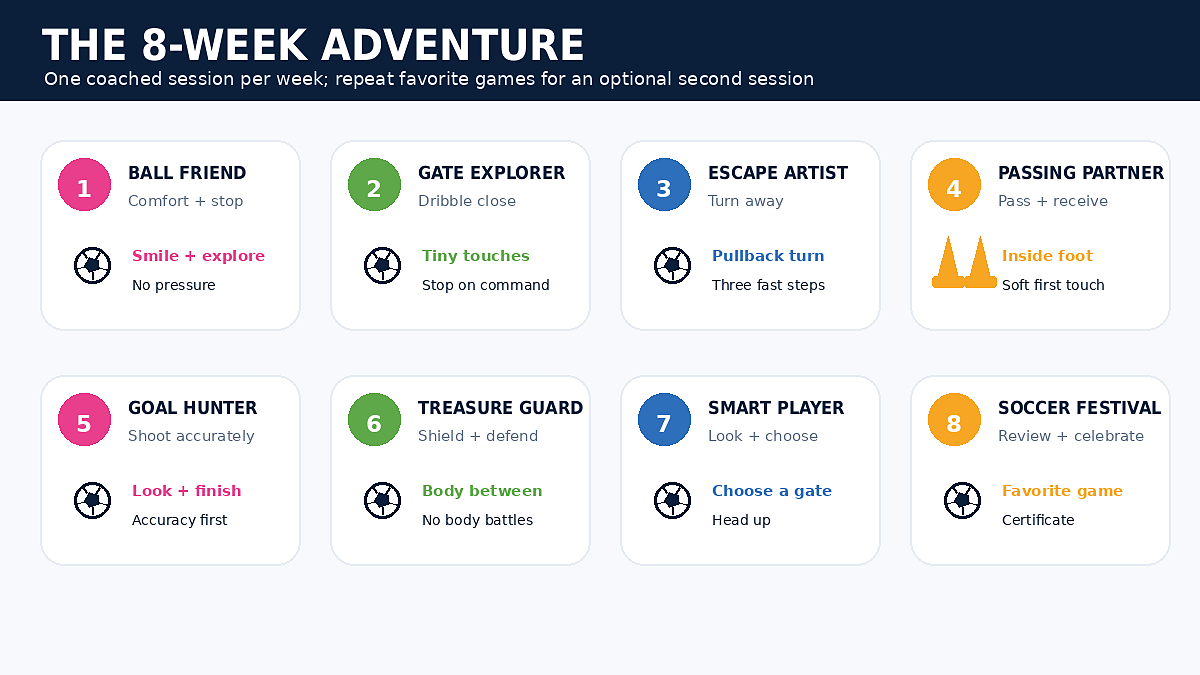
The rule for progression
Move forward when the child can play the game with confidence — not when the technique is perfect. If a week feels hard, repeat it. If she already has the skill, make the game more interesting before making it more technical.
MAKE IT EASIER • Wider gates • Shorter distance • Coach walks instead of defends • More time and fewer rules • Let the child score first | MAKE IT HARDER • Narrower gates • Add a color or direction choice • Use the non-preferred foot naturally • Coach adds light pressure • Ask for a turn before scoring |
! | DO NOT SKIP TO ADVANCED WORK: A six-year-old who can dribble, stop, turn, look up, and enjoy 1v1 has a better foundation than one who memorizes positions or performs cone tricks without understanding the game. |
STAGE 1 BALL FRIEND Comfort with the ball, stopping on command, and enjoying the first session. |
|
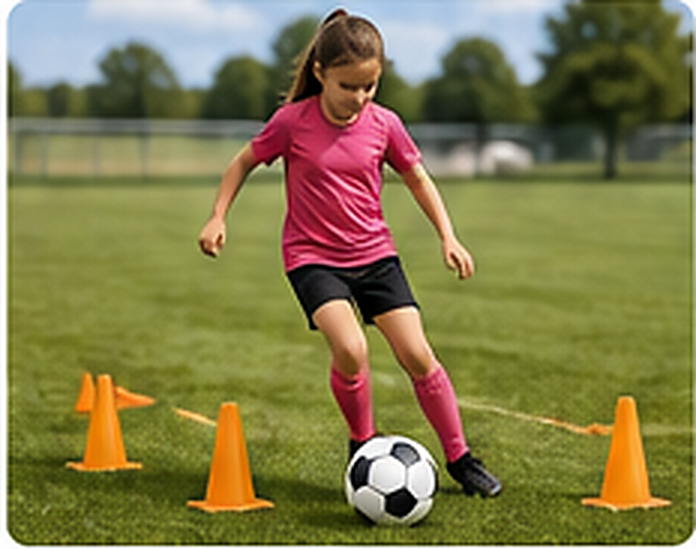
1 | THE ONE THING TO TEACH: Tiny touches when moving; sole of the foot to freeze the ball. |
✓ | SUCCESS LOOKS LIKE: She moves with the ball willingly, can stop it on “red,” and finishes feeling successful. |
45-minute session plan
TIME | ACTIVITY | HOW TO RUN IT |
|---|---|---|
3 min | Hello + choice | Check shoes, shin guards, water, and mood. Let her choose the first cone color. |
5 min | Free Ball Explorer | “Show me three ways to move the ball.” Copy one of her ideas. No corrections. |
7 min | Traffic Lights | Green = dribble, yellow = tiny slow touches, red = stop with sole and look at Trainer Alexis. |
7 min | Body-Part Freeze | Dribble; on “freeze,” stop the ball. Then touch it with knee, elbow, or one foot before restarting. |
2 min | Water + reset | Ask: “Treasure game or goal game first?” |
8 min | Treasure Island | Scatter cones. Dribble to a cone, stop the ball, pick up one treasure, and bring it home. |
10 min | 1v1 to Two Gates | Trainer Alexis walks and gives space. The child scores by dribbling through either gate. Restart quickly. |
3 min | High-five recap | Ask her favorite game. Name one true win. Give the home quest. |
STAGE 1 VISUAL SETUP
Stage 1BALL FRIEND — field card
Comfort with the ball, stopping on command, and enjoying the first session.
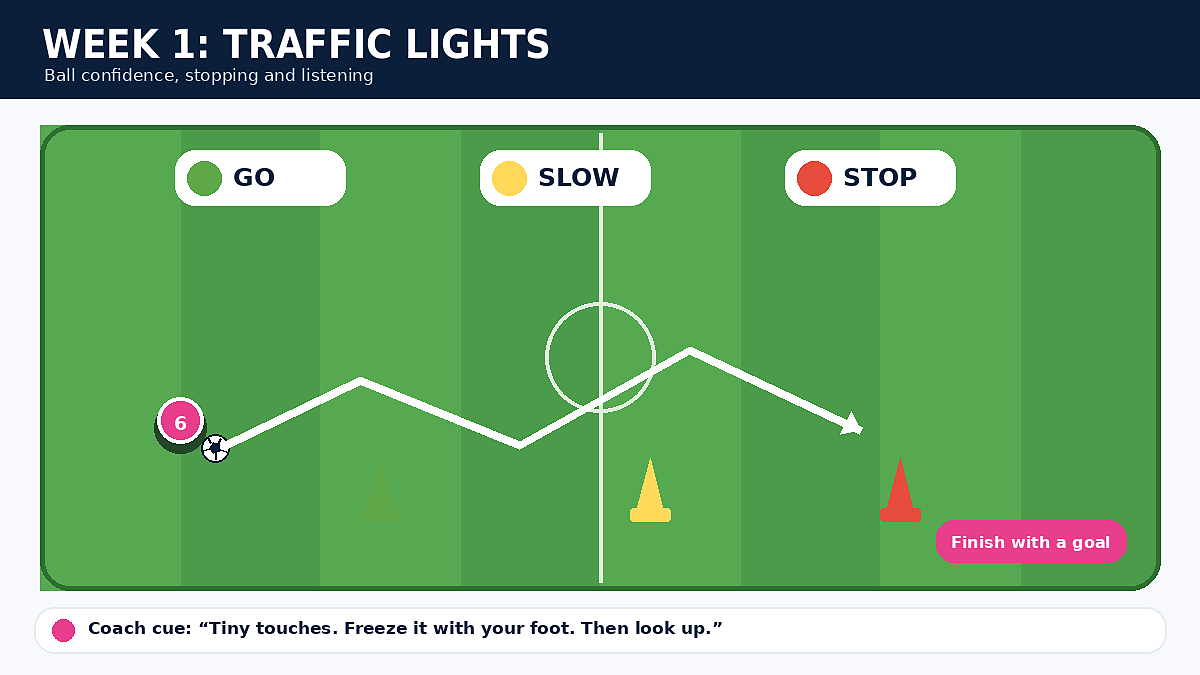
COACH CUES • “Tiny touches.” • “Freeze it with your foot.” • “Ball close, eyes up.” | MAKE IT EASIER • Use a larger area • Call only green and red • Trainer Alexis does not defend |
MAKE IT HARDER • Add yellow speed • Require a stop before scoring • Call a cone color after she starts | WATCH FOR • Do not grab or reposition her foot • Avoid kicking balls toward her • Keep the first 1v1 very easy |
⌂ | 5-MINUTE HOME QUEST: For one favorite song, dribble around five safe objects with a parent nearby. Stop the ball whenever the music pauses. |
? | TRAINER ALEXIS’S REFLECTION: Did she choose to keep playing? Which word worked best: stop, freeze, or red? |
STAGE 2 GATE EXPLORER Closer dribbling touches, changing speed, and keeping the ball within reach. |
|
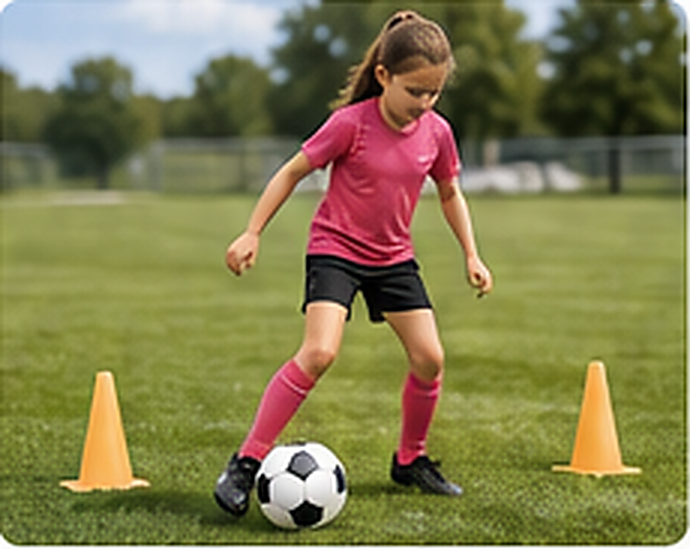
2 | THE ONE THING TO TEACH: Touch the ball softly enough to take the next touch without chasing it. |
✓ | SUCCESS LOOKS LIKE: She dribbles through gates with fewer runaway touches and can speed up or slow down on purpose. |
45-minute session plan
TIME | ACTIVITY | HOW TO RUN IT |
|---|---|---|
3 min | Hello + favorite replay | Repeat 60–90 seconds of her favorite Stage 1 game. |
7 min | Gate Explorer | Build 5–6 colored cone gates. She earns a point each time she dribbles through a new gate. |
7 min | Puppy Ball | The ball is a puppy: close enough to stay with her, not trapped under her feet. Change walking to jogging. |
2 min | Water + reset | Ask which gate color is easiest and which is funniest. |
8 min | Cone-Weave Adventure | Use only 3–4 cones. Curve around them; do not demand a perfect slalom. |
8 min | Race the Coach | Child gets a big head start to a gate. Trainer Alexis uses her weak foot or moves at a walk. |
7 min | 1v1 to Two Gates | Child attacks either goal. Trainer Alexis defends only the middle and lets success happen often. |
3 min | Recap | Praise one moment where the ball stayed close. Home quest. |
STAGE 2 VISUAL SETUP
Stage 2GATE EXPLORER — field card
Closer dribbling touches, changing speed, and keeping the ball within reach.
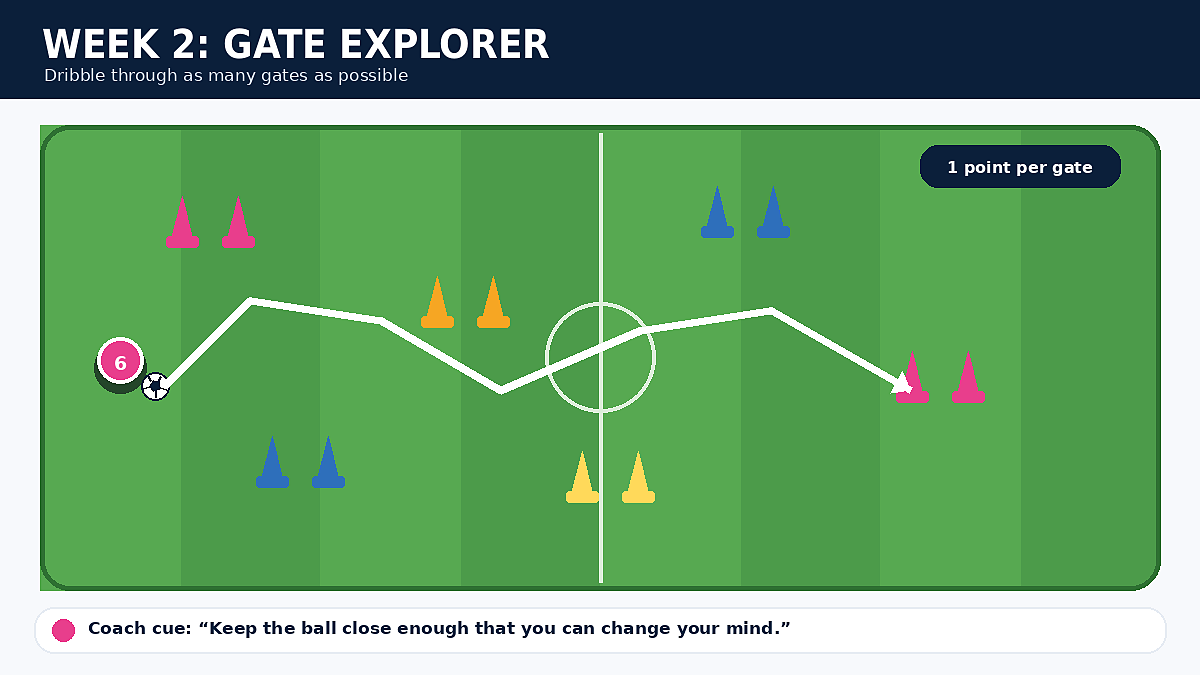
COACH CUES • “Touch, step, touch.” • “Can you change speed?” • “Keep it close enough to turn.” | MAKE IT EASIER • Make gates 4 feet wide • Walk instead of jog • Remove the defender |
MAKE IT HARDER • Gate must be a new color • Add a stop inside each gate • Call a second gate late | WATCH FOR • Do not make cone lines too long • Do not demand both feet every touch • If she chases constantly, shrink speed before space |
⌂ | 5-MINUTE HOME QUEST: Set up two shoe gates 6–8 feet apart. Dribble through one, turn, and return for three minutes. |
? | TRAINER ALEXIS’S REFLECTION: Was the ball closer because of softer touches or because the area was smaller? |
STAGE 3 ESCAPE ARTIST Pullback turns, inside cuts, and changing direction away from pressure. |
|
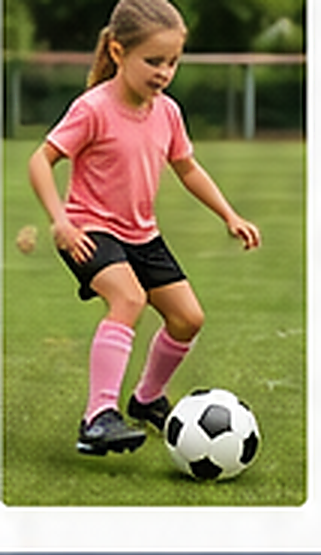
3 | THE ONE THING TO TEACH: Put the sole on top, pull the ball back, turn the body, and take three quick escape steps. |
✓ | SUCCESS LOOKS LIKE: She can use at least one simple turn in a game instead of running straight into pressure. |
45-minute session plan
TIME | ACTIVITY | HOW TO RUN IT |
|---|---|---|
3 min | Hello + free dribble | Let her choose a gate and travel to it in any way. |
6 min | Turn Around the Island | Dribble to one cone, go around it, and return. Let her invent the first turn. |
7 min | Pullback Demo + Try | Show one slow pullback. Let her try several times without correcting every attempt. |
7 min | Inside-Cut Gates | Approach a cone, use inside of foot to push across the body, and escape to a side gate. |
2 min | Water + choice | Ask: shark game or turn-and-score first? |
8 min | Escape the Shark | Trainer Alexis walks behind. Child dribbles to the turn zone, turns, and escapes through a gate. |
9 min | Turn-and-Score 1v1 | Before scoring, the child must change direction once. Trainer Alexis gives obvious space to turn. |
3 min | Recap | Ask her to show her favorite turn one more time. |
STAGE 3 VISUAL SETUP
Stage 3ESCAPE ARTIST — field card
Pullback turns, inside cuts, and changing direction away from pressure.
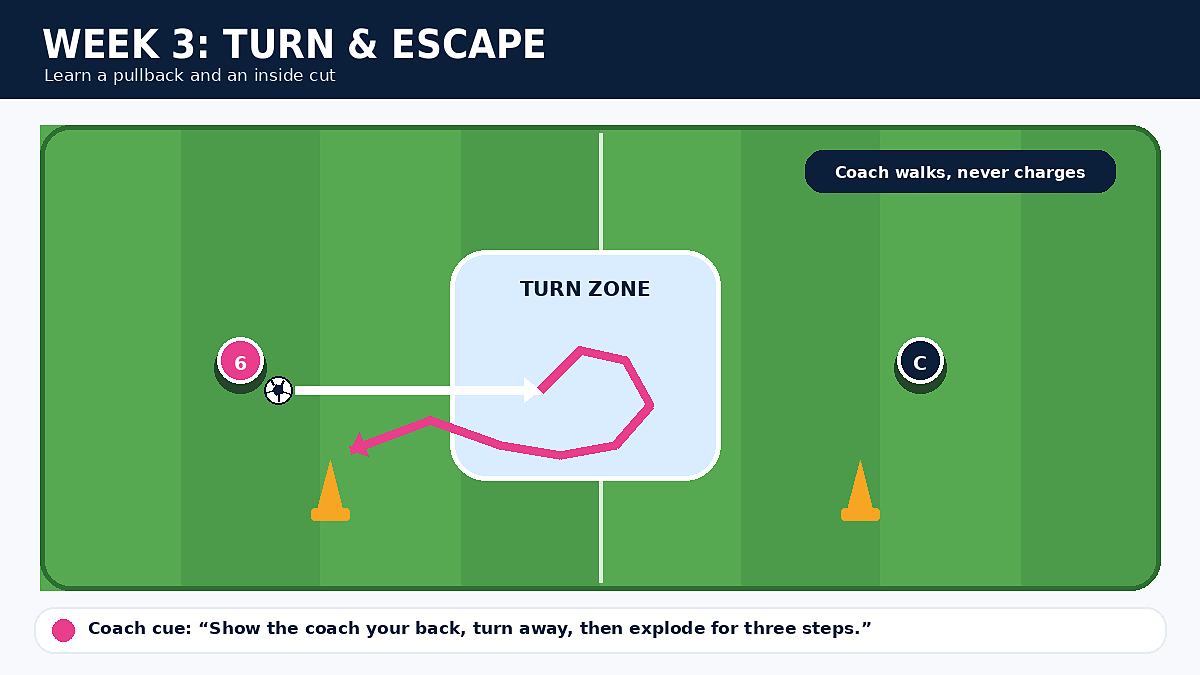
COACH CUES • “Foot on top.” • “Pull it back.” • “Turn away — three fast steps.” | MAKE IT EASIER • Use no defender • Make turn zone large • Allow any turn that works |
MAKE IT HARDER • Trainer Alexis approaches slowly • Choose pullback or inside cut • Score through the opposite gate | WATCH FOR • No sharp pivots on a planted knee • No body contact • Do not teach three turns in one day |
⌂ | 5-MINUTE HOME QUEST: Dribble to a safe marker, pull the ball back, and escape three steps. Repeat five times each direction. |
? | TRAINER ALEXIS’S REFLECTION: Which turn appeared naturally in the final game? Keep that one as her “go-to.” |
STAGE 4 PASSING PARTNER Inside-of-foot passing, receiving a rolling ball, and moving after the pass. |
|
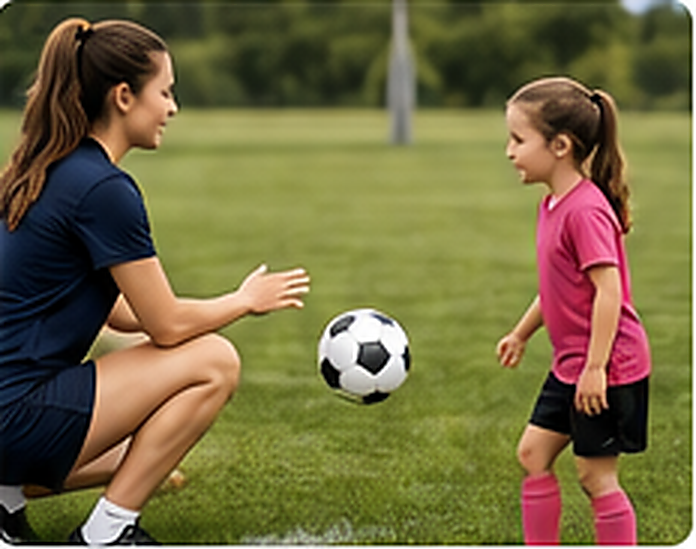
4 | THE ONE THING TO TEACH: Plant beside the ball, open the passing foot, and send the ball to the partner’s feet. |
✓ | SUCCESS LOOKS LIKE: She can exchange short passes with Trainer Alexis and take a softer first touch into space. |
45-minute session plan
TIME | ACTIVITY | HOW TO RUN IT |
|---|---|---|
3 min | Hello + ball roll | Roll the ball back and forth with feet at 4–5 feet. Keep it playful. |
7 min | Pass Through a Gate | Pass through a cone gate to Trainer Alexis. Change gates after three successful passes. |
7 min | Soccer Bowling | Place 3–5 cones as pins. Pass the ball to knock them down; reset together. |
2 min | Water + reset | Ask her to choose the next gate color. |
8 min | First-Touch Treasure | Trainer Alexis rolls the ball. Child cushions it toward a colored cone, then dribbles there. |
7 min | Pass and Move | Pass to Trainer Alexis, move to a new gate, receive the return, and stop the ball. |
8 min | Pass-Then-Score | Child passes to Trainer Alexis, runs around a cone, receives a return, and shoots into a cone goal. |
3 min | Recap | Celebrate a pass that reached feet and a soft first touch. |
STAGE 4 VISUAL SETUP
Stage 4PASSING PARTNER — field card
Inside-of-foot passing, receiving a rolling ball, and moving after the pass.
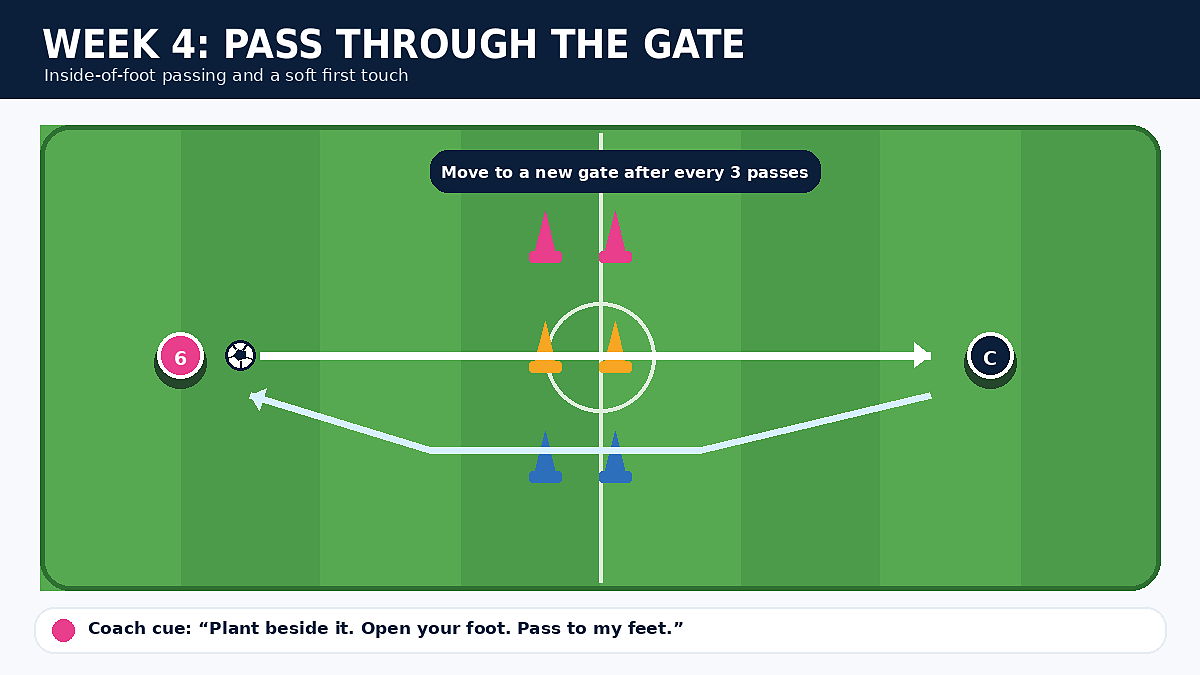
COACH CUES • “Plant beside it.” • “Open your foot.” • “Pass to my feet.” • “Soft first touch.” | MAKE IT EASIER • Move 4 feet apart • Use a wider gate • Roll return passes slowly |
MAKE IT HARDER • Move 7–10 feet apart • Receive toward a called color • Pass, move, and shoot | WATCH FOR • Do not obsess over perfect ankle lock • Avoid long-distance passing • Dribbling still matters more than team tactics |
⌂ | 5-MINUTE HOME QUEST: Pass through a shoe gate to a parent 10 times. Count only passes that stay on the ground — no need for perfect accuracy. |
? | TRAINER ALEXIS’S REFLECTION: Did she understand “pass to feet,” or did a visual gate work better? |
STAGE 5 GOAL HUNTER Balanced shooting, looking at the target, and finishing with accuracy before power. |
|
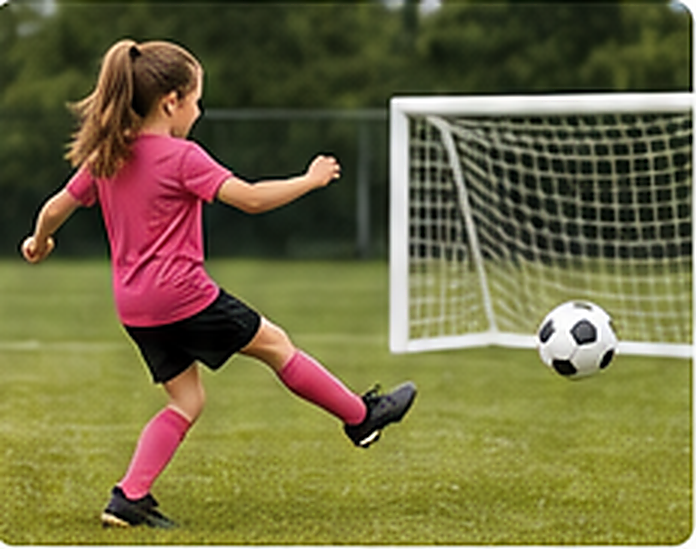
5 | THE ONE THING TO TEACH: Look at the goal, plant beside the ball, swing through, and land balanced. |
✓ | SUCCESS LOOKS LIKE: She can dribble into a shot and direct the ball toward a chosen part of the goal. |
45-minute session plan
TIME | ACTIVITY | HOW TO RUN IT |
|---|---|---|
3 min | Hello + free shots | Give three uncoached shots from a comfortable distance. |
6 min | Look-Plant-Swing | Demonstrate once. Let her strike a still ball through a wide cone goal. |
7 min | Shoot the Corners | Mark two large target zones in the goal. She chooses a color before shooting. |
7 min | Dribble + Finish | Start 8–10 yards away, take 3–5 dribble touches, look up, and shoot. |
2 min | Water + reset | Ask which target she wants to attack next. |
7 min | Knock the Castle | Shoot or firm-pass to knock down cones. Accuracy earns the celebration. |
10 min | 1v1 to Goal | Child attacks a goal. Trainer Alexis shadows at low speed and never blasts a return shot. |
3 min | Recap | Name the best balanced finish, not the hardest kick. |
STAGE 5 VISUAL SETUP
Stage 5GOAL HUNTER — field card
Balanced shooting, looking at the target, and finishing with accuracy before power.
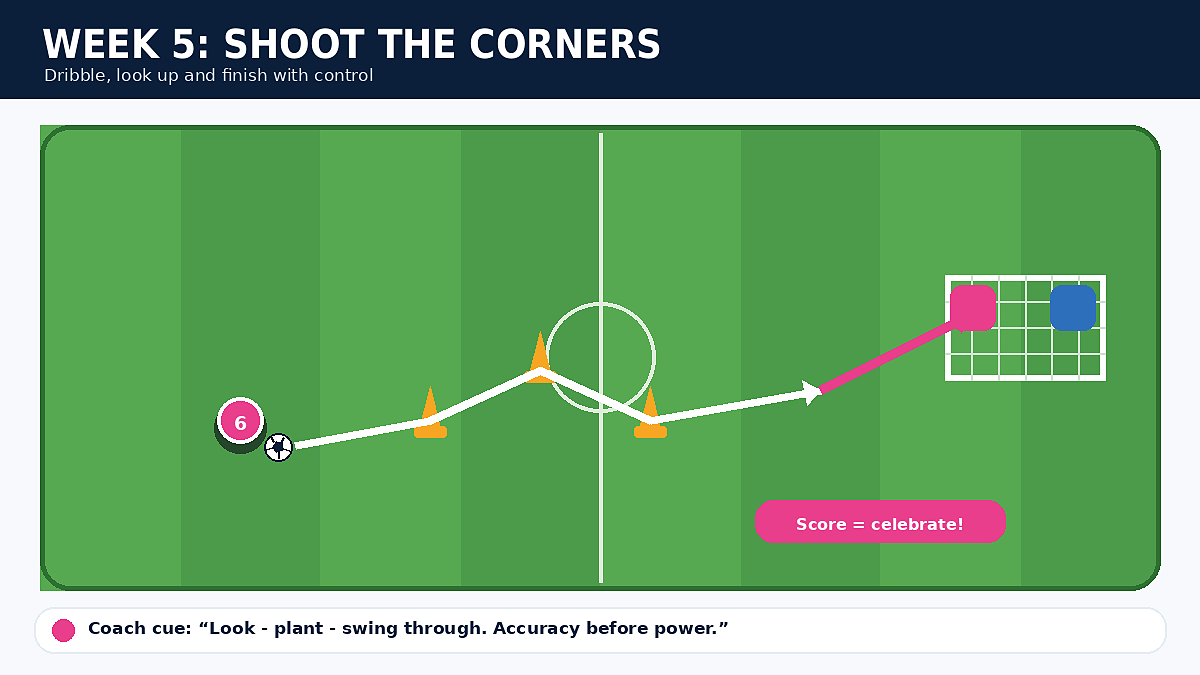
COACH CUES • “Look.” • “Plant beside.” • “Swing through.” • “Accuracy first.” | MAKE IT EASIER • Move closer • Use a 6-foot cone goal • No defender |
MAKE IT HARDER • Dribble around one cone first • Call a target late • Add a walking defender | WATCH FOR • Do not yell “kick harder” • Do not use a full-size goal alone • Chase balls together to avoid dead time |
⌂ | 5-MINUTE HOME QUEST: Make a safe cone or shoe goal. Dribble three touches and pass-shoot through it five times. |
? | TRAINER ALEXIS’S REFLECTION: Was her best strike a laces shot or an inside-foot finish? Let success guide the technique. |
STAGE 6 TREASURE GUARD Shielding the ball, introductory defending, and winning it without reckless contact. |
|
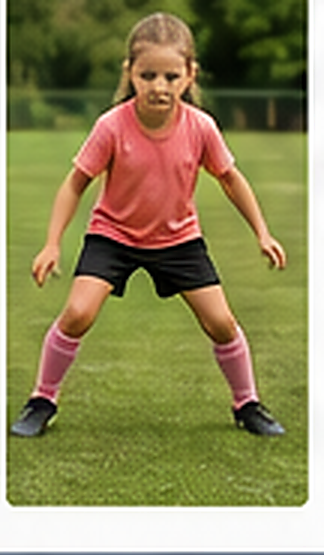
6 | THE ONE THING TO TEACH: Keep the body between the defender and the ball; turn away from pressure. |
✓ | SUCCESS LOOKS LIKE: She can protect the ball briefly and defend by staying between ball and goal instead of diving in. |
45-minute session plan
TIME | ACTIVITY | HOW TO RUN IT |
|---|---|---|
3 min | Hello + favorite dribble | Repeat a gate or turn game for confidence. |
6 min | Mirror Feet | Face Trainer Alexis without a ball. Copy side steps, small forward/back steps, and balanced stops. |
7 min | Protect the Treasure | Child shields a stationary or slowly moving ball. Trainer Alexis applies only light toe-poke pressure. |
7 min | Body Between | Place ball, child, and cone goal in a line. Show how to put the body between Trainer Alexis and ball. |
2 min | Water + reset | Ask: defend first or attack first? |
7 min | Win and Escape | Trainer Alexis dribbles slowly. Child wins or touches the ball, then escapes through a gate. |
10 min | 1v1 to Two Goals | Switch roles often. Defending cue is “between ball and goal”; attacking cue is “turn away.” |
3 min | Recap | Praise safe patience, not just steals or goals. |
STAGE 6 VISUAL SETUP
Stage 6TREASURE GUARD — field card
Shielding the ball, introductory defending, and winning it without reckless contact.
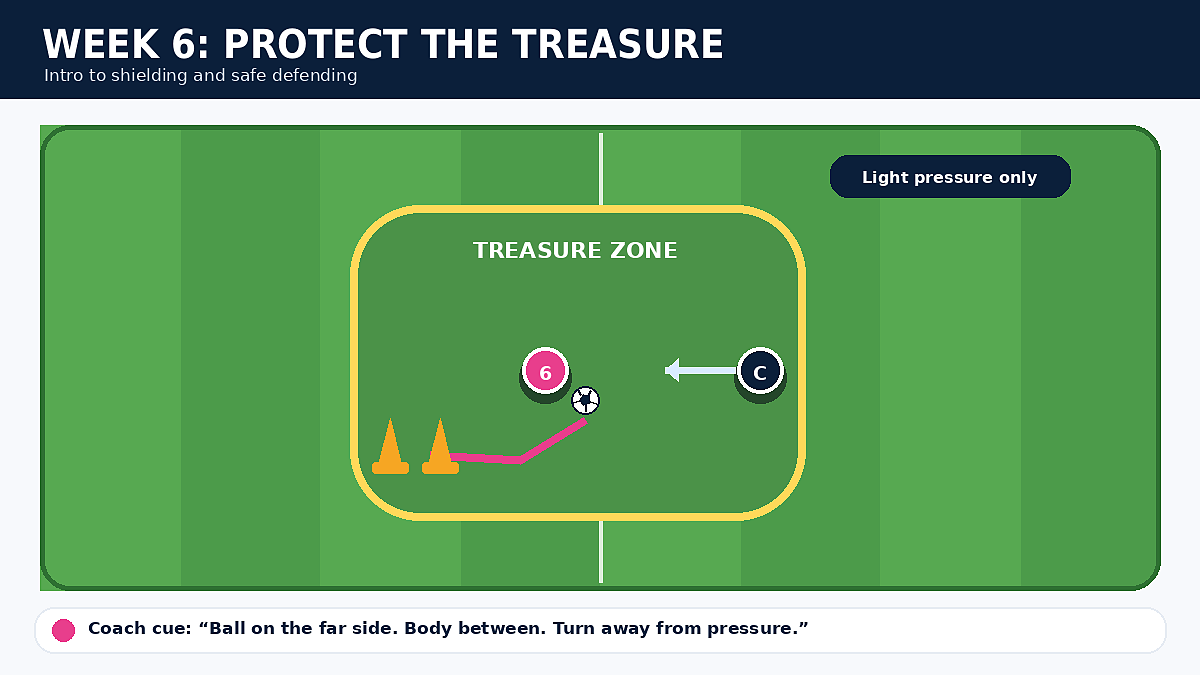
COACH CUES • “Body between.” • “Ball on the far side.” • “Small steps.” • “Don’t dive in.” | MAKE IT EASIER • Use a stationary ball • Trainer Alexis walks • Make escape gate close |
MAKE IT HARDER • Ball moves slowly • Add two escape gates • Switch attack/defend on each turn | WATCH FOR • No shoulder charges • No slide tackles • No pulling or body battles • Trainer Alexis must reduce her size and speed advantage |
⌂ | 5-MINUTE HOME QUEST: With a parent standing still as a cone, dribble around them while keeping the ball on the far side. No contact. |
? | TRAINER ALEXIS’S REFLECTION: Did she defend by chasing the ball or by protecting the goal? Praise the second behavior. |
STAGE 7 SMART PLAYER Looking up, choosing a direction, and deciding whether to dribble, pass, turn, or shoot. |
|
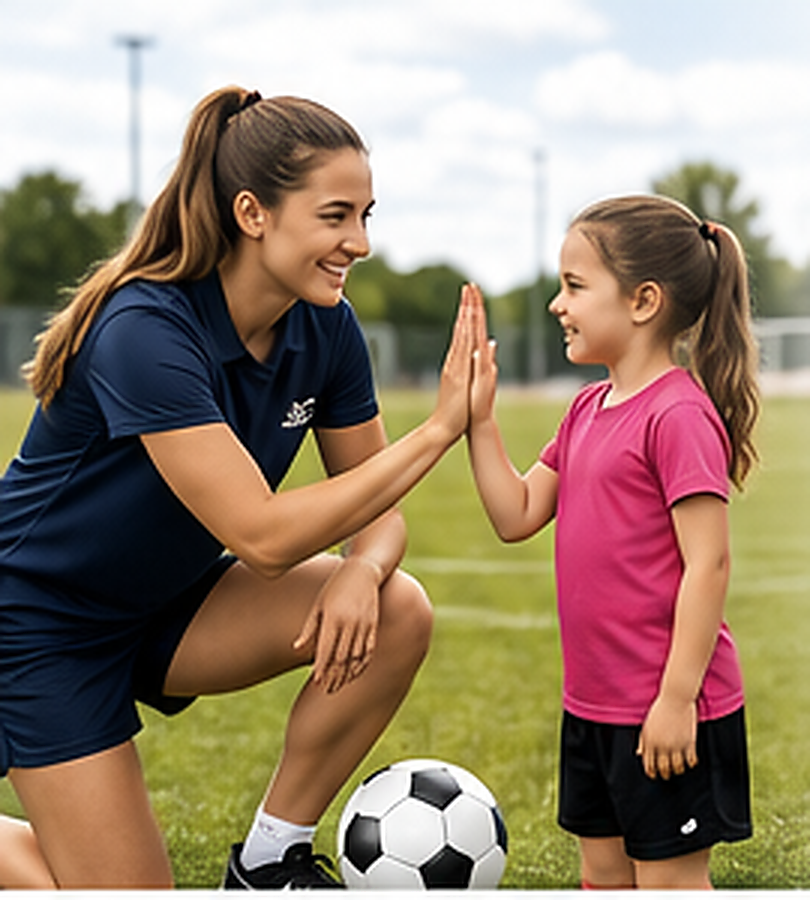
7 | THE ONE THING TO TEACH: Look before the next touch and choose the open gate. |
✓ | SUCCESS LOOKS LIKE: She begins to make simple soccer decisions instead of following a memorized cone path. |
45-minute session plan
TIME | ACTIVITY | HOW TO RUN IT |
|---|---|---|
3 min | Hello + player choice | She chooses one favorite game to start. |
7 min | Color Choice | Begin in the middle. Trainer Alexis calls a color after she starts; she scans and dribbles to that gate. |
7 min | Go-Turn-Pass-Shoot | Trainer Alexis calls one action. Child performs it, then returns to free dribble. |
2 min | Water + reset | Ask: “What helps you see the gates?” |
8 min | Two-Gate Decision | Trainer Alexis blocks one gate slowly. Child looks up and attacks the open gate. |
8 min | Pass or Dribble? | Trainer Alexis can be a wall-pass option. Child chooses to pass or dribble around a cone defender. |
7 min | Smart-Player 1v1 | Two goals. Bonus celebration for changing direction or looking up before scoring. |
3 min | Recap | Ask her to explain one choice she made. Keep the answer simple. |
STAGE 7 VISUAL SETUP
Stage 7SMART PLAYER — field card
Looking up, choosing a direction, and deciding whether to dribble, pass, turn, or shoot.
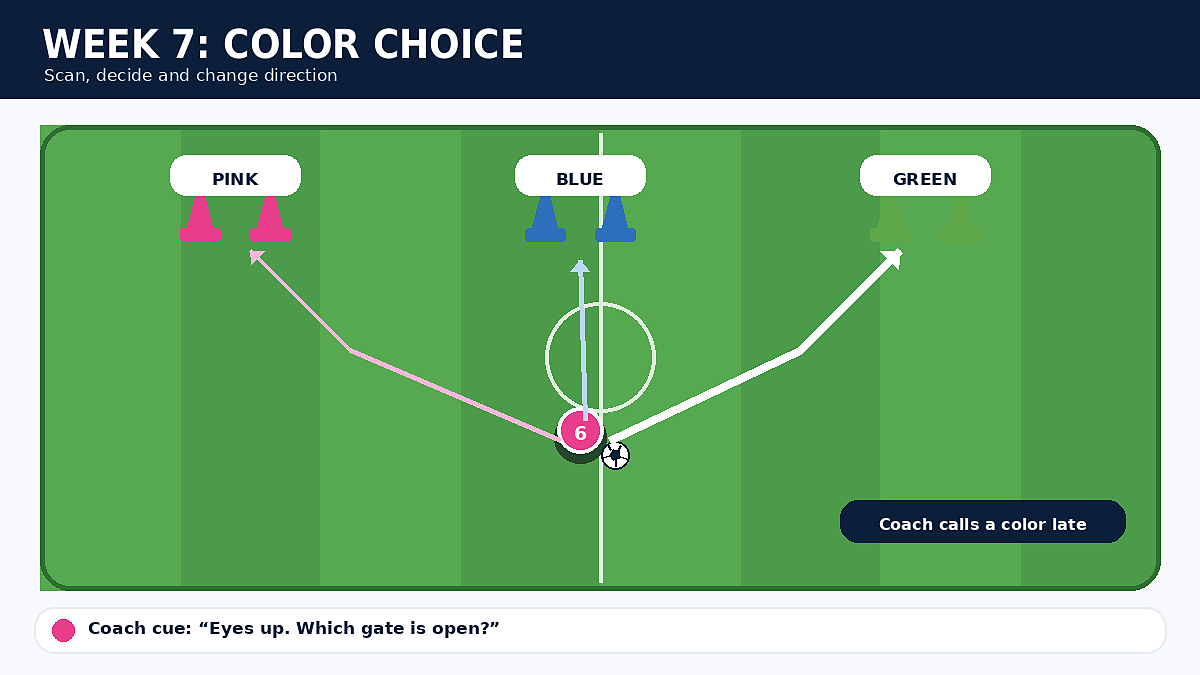
COACH CUES • “Eyes up.” • “Which gate is open?” • “Can you change your mind?” | MAKE IT EASIER • Call color early • Stand completely out of the way • Use only two gates |
MAKE IT HARDER • Call color later • Block one gate • Add pass-to-coach option | WATCH FOR • Do not turn decision games into verbal quizzes • Let her choose wrong and learn • Avoid constant sideline directions |
⌂ | 5-MINUTE HOME QUEST: A parent calls left or right while she dribbles toward two safe gates. Call the direction late enough that she must look. |
? | TRAINER ALEXIS’S REFLECTION: How often did Trainer Alexis let the child decide without giving the answer? |
STAGE 8 SOCCER FESTIVAL Reviewing every skill, playing the favorite games, and ending with confidence. |
|
8 | THE ONE THING TO TEACH: Use the right simple action for the moment — and enjoy it. |
✓ | SUCCESS LOOKS LIKE: She completes a playful skill course, uses skills in 1v1, and can name what she is proud of. |
45-minute session plan
TIME | ACTIVITY | HOW TO RUN IT |
|---|---|---|
3 min | Hello + celebration plan | Tell her today is the soccer festival. She will choose part of the session. |
6 min | Favorite Warm-Up | Replay the favorite game from any prior week. |
12 min | Adventure Course | Dribble cones, pass through a gate, make a turn, and finish on goal. Keep the course flowing. |
2 min | Water + reset | Ask what part she wants to improve or repeat. |
7 min | Personal-Best Round | Try the course again with a child-chosen challenge — not necessarily faster. |
7 min | Favorite Skill Challenge | She chooses passing, shooting, turning, or gates. Trainer Alexis follows her lead. |
5 min | Celebration Match | Short 1v1 with easy restarts and plenty of goals. No official score needed. |
3 min | Certificate + recap | Ask: “What are you proud of?” Present the certificate and share parent update. |
STAGE 8 VISUAL SETUP
Stage 8SOCCER FESTIVAL — field card
Reviewing every skill, playing the favorite games, and ending with confidence.
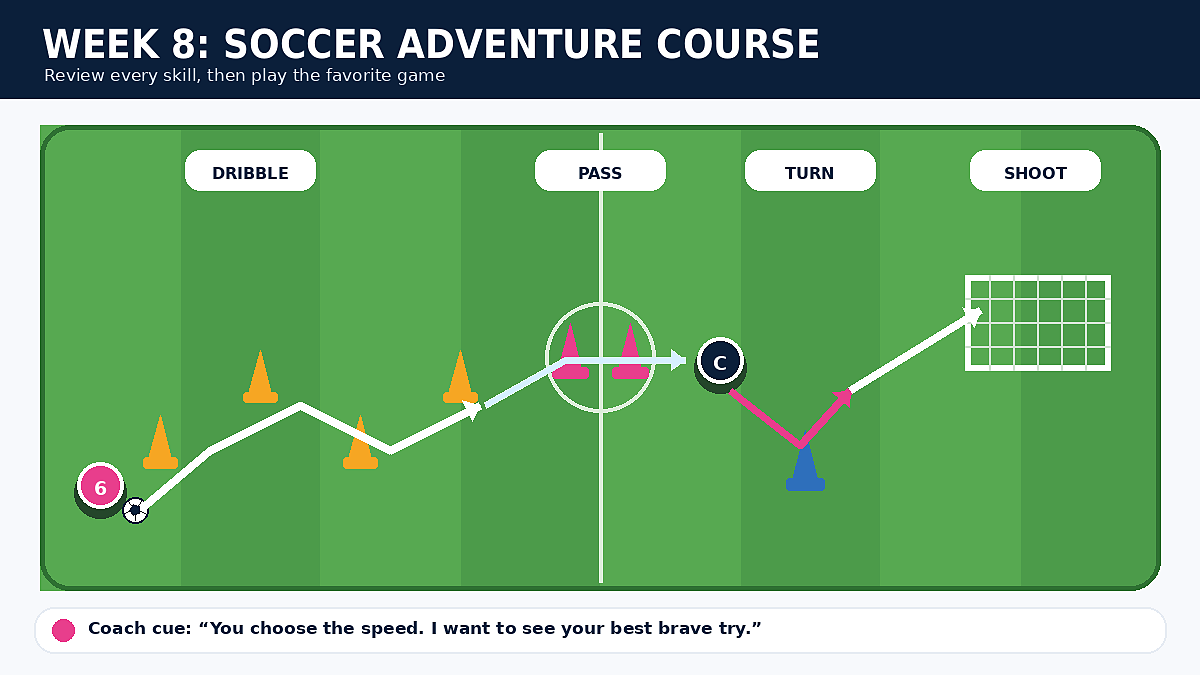
COACH CUES • “Show me what you know.” • “You choose.” • “Best brave try.” | MAKE IT EASIER • Remove one course station • Walk through first • Let her choose every target |
MAKE IT HARDER • Add a color decision • Time only if she requests it • Coach adds light pressure at one station | WATCH FOR • Do not turn the final session into a test • Do not compare Stage 1 and Stage 8 with criticism • Celebrate confidence and effort |
⌂ | 5-MINUTE HOME QUEST: Create a new soccer game and teach it to someone in the family. The rule: everyone should get lots of touches and have fun. |
? | TRAINER ALEXIS’S REFLECTION: What made her most proud? That answer should shape whatever training comes next. |
APPENDIX A
Game library — dribbling, stopping, and turning
Use these to replace an activity that is not working, repeat a favorite, or create an optional second session.
1 | RED LIGHT, GREEN LIGHT — Dribbling + stopping. 10 x 15 yard box. Green = go, yellow = tiny touches, red = stop with sole and look up. Add a goal after three clean stops. |
2 | GATE EXPLORER — Dribbling + scanning. Scatter 5–8 colored gates. Dribble through a new gate each time. Progress by calling a color late. |
3 | PUPPY BALL — Close control. The ball is a puppy that stays near the player. Change from walk to jog, then add turns when the puppy “runs away.” |
4 | TREASURE ISLAND — Stop + start. Scatter cones as treasure. Dribble to one, stop the ball, collect it, and return to home base. |
5 | ESCAPE THE SHARK — Turning. Coach walks behind as the shark. Player reaches a turn zone, turns away, and escapes through a gate. |
6 | BODY-PART FREEZE — Balance + fun. Dribble; on freeze, stop with the sole and touch the ball with a called safe body part such as knee, elbow, or foot. |
! | RESCUE RULE: If attention drops, do not add more words. Switch to a game with a clear story, a visible target, and an immediate chance to score. |
APPENDIX A
Game library — passing, shooting, defending, and 1v1
1 | SOCCER BOWLING — Passing accuracy. Pass a rolling ball to knock down 3–5 cones. Move closer after misses; move farther only after success. |
2 | PASS THROUGH THE GATE — Inside-foot passing. Player and coach pass through colored cone gates. Change the gate after three passes. |
3 | FIRST-TOUCH TREASURE — Receiving. Coach rolls the ball. Player cushions the first touch toward a called cone, then dribbles there. |
4 | KNOCK THE CASTLE — Shooting accuracy. Shoot or firm-pass to knock down cone castles. Celebrate accuracy, not power. |
5 | SHOOT THE CORNERS — Finishing. Create two large target zones in a mini goal. Player chooses the target before the dribble begins. |
6 | PROTECT THE TREASURE — Shielding. Player keeps body between coach and ball. Coach gives light toe-poke pressure only. Escape through a gate. |
7 | TWO-GOAL 1v1 — Decision making. Two cone goals give the attacker choices and reduce straight-line collisions. Switch roles often. |
8 | COLOR CHOICE — Scanning. Player begins centrally. Coach calls or opens a colored gate late. Player looks up and changes direction. |
APPENDIX B
Technical cues and troubleshooting
A six-year-old needs a picture and a short phrase, not a biomechanics lecture.
One-sentence teaching cues
DRIBBLING • “Tiny touches so you can change your mind.” • Use inside, outside, or laces — whichever keeps the ball moving. | STOPPING • “Put your foot on top and freeze it.” • Knee soft; do not stomp. |
TURNING • “Pull it back, turn away, three fast steps.” • One useful turn is enough. | PASSING • “Plant beside it, open your foot, pass to my feet.” • Keep the pass on the ground. |
RECEIVING • “Soft touch into your space.” • Do not trap it dead every time. | SHOOTING • “Look, plant, swing through.” • Accuracy before power. |
DEFENDING • “Between ball and goal. Small steps. Don’t dive in.” • No slide tackles. | SHIELDING • “Body between, ball far side, turn away.” • Use light pressure only. |
When something is not working
1 | She will not listen — Reduce words, demonstrate, and offer two choices. Check whether the activity is too hard or too long. |
2 | She keeps chasing the ball — Slow down and shrink the area. Ask for tiny touches for only ten seconds, then play. |
3 | She is afraid of the ball — Use slow rolling balls, no shots toward her, more distance, and a softer ball if appropriate. |
4 | She gets frustrated — Make the target bigger, remove the defender, let her score, and praise the next brave attempt. |
5 | She only wants to shoot — Build a turn, gate, or pass into the path to the goal. Do not remove shooting; use it as the reward. |
6 | She uses only one foot — Place gates and targets so the other foot becomes convenient. Never shame or force it. |
7 | Trainer Alexis is winning too easily — Walk, use weak foot, count to three before defending, or defend only one gate. |
8 | The session feels flat — Ask the child to rename the game, choose a color, or invent one new rule. |
APPENDIX C
Progress tracker and parent update
Use “E” for emerging, “D” for developing, and “C” for consistent. Do not score the child in front of her.
SKILL / HABIT | W1 | W2 | W3 | W4 | W5 | W6 | W7 | W8 |
Enjoyment / willingness to play | ||||||||
Listens to one simple cue | ||||||||
Dribbles with ball in reach | ||||||||
Stops the ball on command | ||||||||
Changes direction with a turn | ||||||||
Passes a rolling ball toward feet | ||||||||
Receives with a softer first touch | ||||||||
Shoots toward a target with balance | ||||||||
Defends safely between ball and goal | ||||||||
Tries again after a mistake |
30-second parent update template
✉ | MESSAGE: “Today we worked on __________. Her biggest win was __________. Her favorite game was __________. Next time we will keep building __________. No safety concerns / Safety note: __________.” |
Trainer Alexis’s after-session reflection
What made her smile? _____________________________________________
What was too easy or too hard? _____________________________________________
What one cue helped? _____________________________________________
Did I talk too much? _____________________________________________
What will I repeat next time? _____________________________________________
APPENDIX D
Parent intake and training agreement template
This is a planning and communication template, not a legal waiver. Club, facility, and local requirements may require additional forms.
Child’s name _______________________________________________________
Date of birth / age ________________________________________________
Parent / guardian name ____________________________________________
Phone and emergency contact ______________________________________
Training location and normal day / time _____________________________
Health and participation notes
Allergies / asthma / medications ______________________________________
Recent injuries or medical restrictions ______________________________________
Sensory, attention, communication, or learning needs ______________________________________
Prior soccer experience ______________________________________
What the child enjoys or avoids ______________________________________
Agreements
[ ] A responsible adult will remain on-site, within sight, and available for the entire session.
[ ] All communication with the child will be open and routed through a parent or guardian.
[ ] The parent or guardian remains responsible for medical decisions, medication, transportation, and emergencies.
[ ] No heading, slide tackling, private spaces, rides, or injury treatment will be part of training.
[ ] Photos or video: [ ] Not allowed [ ] Allowed for private skill review only [ ] Other: __________
[ ] The session may be shortened or canceled for weather, pain, illness, fatigue, or safety concerns.
Parent / guardian signature and date ______________________________
Trainer Alexis signature and date _______________________________________
Trainer Alexis’s parent / guardian acknowledgement _________________________
TEAR-OUT PAGE
Trainer Alexis’s field-side quick card
Take a phone photo of this page. This is the only page she should need during a normal session.
ONE CUE | LOTS OF PLAY | TWO CHOICES | END POSITIVE |
Before
CHECK • Adult present • Field and goals safe • Size 3 ball, shin guards, water • Weather plan clear | SAY • “We’ll play soccer games for about 45 minutes.” • “You can ask for water or a break anytime.” • “Pick pink or blue for our first game.” |
During
COACH LOOP • Show once • Say one cue • Let her try • Praise something true • Play on | DEFAULT CUES • Tiny touches • Freeze it • Eyes up • Plant beside it • Body between |
WHEN SHE STRUGGLES • Make goal bigger • Remove defender • Move closer • Switch game • Let her score | WHEN TRAINER ALEXIS IS TOO GOOD • Walk • Use weak foot • Give head start • Defend one gate • Count to three |
End
• Replay her favorite game for 1–2 minutes.
• Ask: “What was your favorite part?”
• Name one specific win.
• Give one five-minute home quest.
• Tell the parent one win and one next focus.
★ | THE STANDARD: She should leave feeling more confident than when she arrived. |
SOCCER ADVENTURE CERTIFICATE Presented to ________________________________________ for eight stages of brave tries, joyful play,
Favorite game: ______________________________ Coach Trainer Alexis: ____________________ Date: _______________ Keep playing. Keep learning. Keep loving the ball. |
RESEARCH AND SOURCES
Reference notes
This guide adapts authoritative youth-soccer, physical-activity, safeguarding, concussion, and weather guidance for a parent-supervised, one-on-one setting.
1 | U.S. Soccer. “Five Things to Know About the 4v4 Online Grassroots Course.” Fun, safe, developmentally appropriate environments; player-centered approach; Play-Practice-Play. |
2 | U.S. Youth Soccer. Official US Youth Soccer Coaching Manual. U-6 characteristics; brief directions; short activities; water breaks; 45-minute sessions; one ball per player. |
3 | U.S. Soccer / U.S. Youth Soccer. Player Development Initiatives — 4v4 Standards of Play. Size 3 ball, no goalkeepers, shin guards, small-sided play, and fun/safe environment. |
4 | Centers for Disease Control and Prevention. “Child Activity: An Overview.” Updated Dec. 4, 2025. Children ages 6–17 should get at least 60 minutes of daily activity; activities should be varied and age-appropriate. |
5 | U.S. Center for SafeSport. 2025 Minor Athlete Abuse Prevention Policies. Observable and interruptible individual sessions, advance parent consent, and parent observation for covered adult-minor training. |
6 | U.S. Youth Soccer. Players and Playing Rules Policy, Rule 305 — Heading. Players age 10 and under shall not head the ball in matches or organized training. |
7 | Centers for Disease Control and Prevention, HEADS UP. “Signs and Symptoms of Concussion.” Common observed and reported concussion signs and symptoms. |
8 | U.S. Soccer Learning Center. “Lightning and Severe Weather.” Outdoor activity may resume 30 minutes after the last thunder or lightning. |
9 | American Academy of Pediatrics. “Soccer Injuries in Children and Adolescents.” Pediatrics, 2019. Youth soccer injury prevention and protective-equipment context. |
Important notes
• This document is educational and does not replace medical advice, emergency procedures, a club safeguarding policy, or local rules.
• The U.S. Youth Soccer coaching manual is an older publication still hosted by US Youth Soccer; its U-6 developmental recommendations were cross-checked against current U.S. Soccer grassroots principles.
• The one-on-one drills, field sizes, and eight-stage progression are original adaptations for this specific mentoring situation, not official U.S. Soccer session plans.
• Generated illustrations are generic and do not depict Trainer Alexis or the child being trained. Original drill diagrams were created specifically for this guide.
• Web sources accessed July 17, 2026.